Native Guide
Material culture and appearance of the Alabama people, including clothing, weapons, jewelry, and trade goods of the Creek Confederacy.
The Interpreter's Role
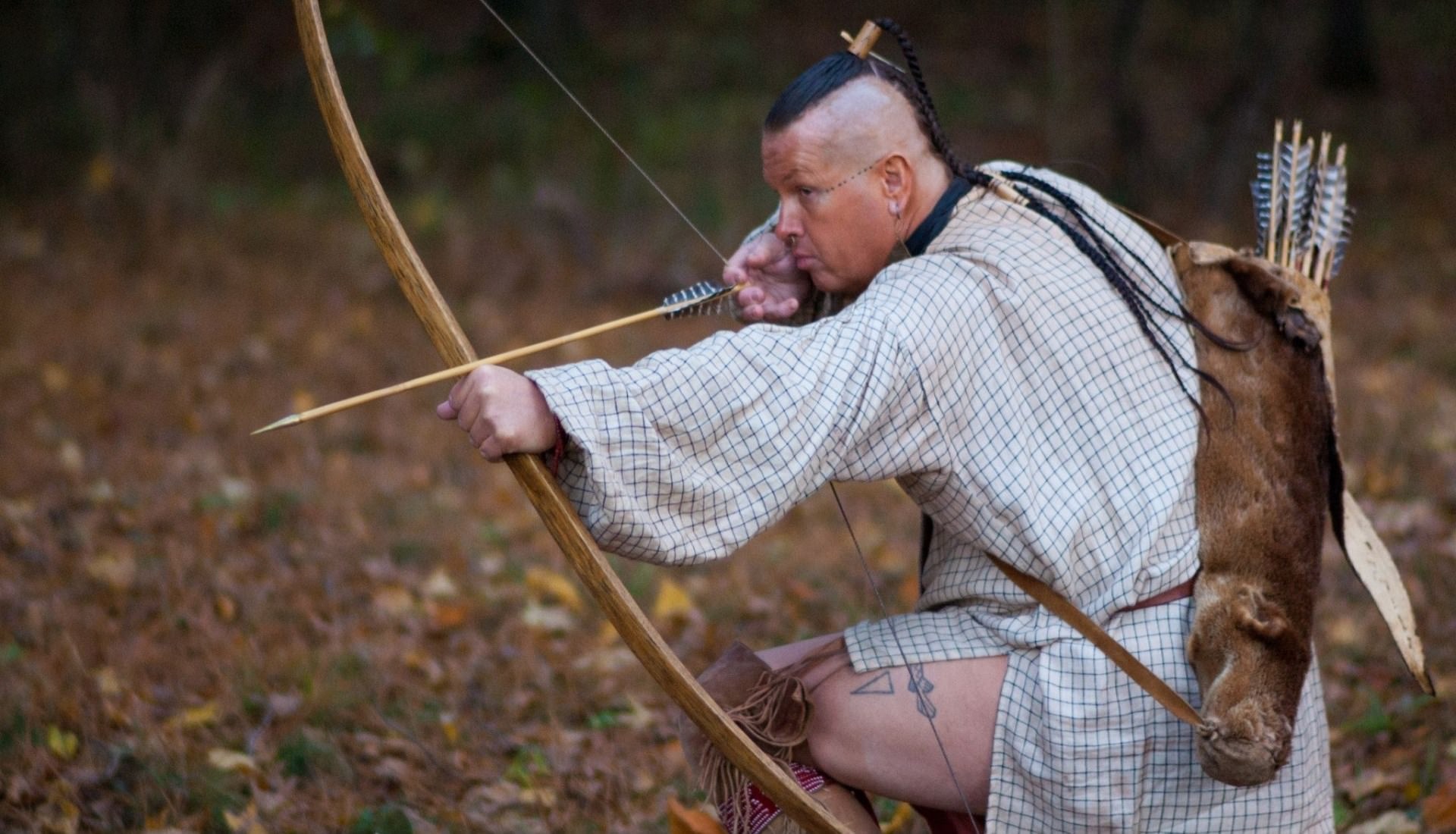
Welcome to this great pastime. To be a native interpreter is a unique challenge but a very rewarding one. As interpreters at Fort Toulouse we are always striving to present to the public an accurate cross-section of the Native and French inhabitants of the area. The primary goal is to give guidelines concerning the use of the material culture of the native people (the Alabamas) and how it would affect their appearance. The time period we concentrate on is the French contact period with the target year of 1756: the beginning of the French and Indian War.
As in any other type of reenacting there is debate to what exactly the people being emulated looked and dressed like. This problem is compounded by the fact that there is so little information in the way of sketches and good first person accounts. Due to this lack of information we sometimes look at period sketches of various eastern woodland native people to gain a sense of colonial style. It may not be possible to document some items to the Alabamas specifically, but the main emphasis is to develop a colonial southern look.
The People & The Interpreter
The faction of the Creek Confederacy that lived near Fort Toulouse were known as the "Alabamas." These people, like all southern tribes, had become very dependent upon the Deerskin Trade and had 40 years of close contact with the French inhabitants of the fort. This trade system, conducted primarily with the French and English, had a great impact on the Colonial Indian in many areas, including appearance.
Native people dressed in very unique and expressive ways. For both sexes, jewelry and various ornamentation was a form of expression that promotes tribal identity, social ideas of style, and sometimes outward expression of religious beliefs. There is the perception that native people always wear the most elaborate things they owned; however, this is not the case. In most cultures we dress for the occasion and this is very true in native society. The ceremonial outfits are great for dances or social events such as a parlay, but for hunting, everyday working, tanning hides, cooking, and fighting, such attire is neither practical nor correct.
The education of the public as to the existence and the appearance of these people is a challenge. It is important to honor the people that we are emulating. They were not saints nor devils, just people trying to survive in a fast changing world where their society had turned turbulent due to external European politics combined with the influx of trade goods.
Clothing & Equipment for Men
As a male interpreter the role that you take on is one of a hunter and warrior. For demonstration purposes we need to be mending gear, building projects that serve the village, and interacting with our French brothers and sisters.
Hair Style
Nothing personifies a native impression more than the hair style and color. The hair color of these people is described as dark, almost black. If your hair color is fair, then you should consider a head covering or a dye job. The most common hairstyle for men was variations on the scalplock. The bowl cut is a viable alternative, seen in the Von Reck sketches. There is reference in Adair to an Indian male wearing a silk scarf tied about his head. Hair ornaments such as silver and cane hair tubes, finger woven pendants, small roaches of deer hair, and hanks of feathers all accent the hairstyle.
Shirts
The trade shirt is an important item of the Deerskin trade. These shirts were probably of linen and white seems most prevalent, however, stripes, checks and some prints are mentioned in various trade lists. Be very careful of the fabric you choose: the method of printing during this period was block printing. Woven stripes and checks are easier to find but be certain the material is at least 100% cotton, linen, wool, or cotton/linen blends. No synthetics. For dress-up occasions, native males wearing white linen shirts with ruffles on the cuffs and at the neck slit make for a stunning image.
Breech Cloth
The one male garment that is very universal in native society. A long piece of stroud passed between the legs and secured to the body by a belt or thong. The breech cloths seen in the Von Reck sketches hang down to mid-thigh in front and back, and the width appears to be around 10 inches. Silk or woolen tape can dress up the garment.
Leggings
Used in conjunction with the breech cloth for lower body covering. Usually constructed of buckskin or wool stroud. The most common type is the side flap, covering from the ankle to about mid-thigh where a strap is attached. Usually also supported by garters tied beneath the knee. Wool stroud commonly appears in red and navy blue, with white, black, and brown also seen.
Footwear
The moccasin is the most common native footwear, made of tanned deer or elk skin. The typical southeastern work moccasin used by the Seminoles during the 19th century is probably very close to the style used in earlier time periods. The commercially produced moccasins do not come close to the proper style, but group members can give assistance. Colonial buckle shoes are another option, as they appear on trade lists. Or go barefoot.
Sashes & Garters
In many sketches, Indian males are pictured with woven sashes and garters. Adair mentions women weaving wool yarn to produce sashes, garters, and shot pouches decorated with stripes and checkers. To start, a strip of woolen stroud and a leather belt will substitute. Finger woven pieces are high-dollar items that should be selected carefully. Beware of loom-woven sashes and garters sold at rendezvous; these are not of the correct construction.
Coats & Match Coats
During winter, a piece of stroud or blanket called a match coat serves as a very utilitarian garment, wrapped in toga fashion. Coats that mimicked the military coats of the French and British armies were also popular trade items. Waistcoats should be constructed of a 1750s pattern. These are costly items requiring much research before purchase.
Jewelry
Glass trade beads used as necklaces were popular among both sexes, with several accounts of women wearing blue beads. Few beads on the market are of the correct style for our time period; reference The Tunica Treasure by Jeffrey P. Brain. Wrist bracelets of brass were very common and cheap to make (use 1/8" brass welding rods). Silver ear bobs for pierced ears are very common; note the short cone and dome-shaped bottom on the originals in the visitors center. Be very careful when buying: look at original items first.
Weapons
The most prized weapon was the flintlock trade musket, the most costly part of your outfit but one you will treasure. Both French and English trade muskets are appropriate: French type C or D trade guns, English Type G or Wilson trade guns. You will also need a proper shot pouch and powder horn. Consult with group members before purchase.
Knife
A tool and a weapon. The typical knife was a butcher's knife similar to the chef's knife. Hollywood has convinced everyone that a frontier person needs a 14" knife with a huge brass cross guard, but this is not historically correct or practical. Adair mentions Creek men with scalping knives in sheaths around their neck, a style prevalent in the northeast and used in the southeast as well.
Hatchet
The iron hatchet was a very utilitarian tool for splitting wood and could also be used as a weapon. Sometimes referred to as "tomahawks." There are originals on display in the visitors center for reference.
Clothing & Equipment for Women
As a female you have a very important role in Creek society. It is true that a large amount of the work was performed by the women, however, the Creek people have a matriarchal society in which the women own the houses and the land. For demonstration purposes, the women would be cooking, chopping wood, tanning hides, finger weaving, twinning, basket making, working in the garden, preparing food for winter storage, and interacting with our French brothers and sisters. A large majority of beautiful Native American art was made by the women.
Hair
The women would grow their hair long, enough to pull back into a braid. Bartram says they "never cut their hair, but plait it in wreaths, which are turned up, and fastened on the crown with a silver broach, forming a wreathed top-knot, decorated with an incredible quantity of silk ribbands, of various colors," though decorations were worn only on special occasions. Bossu describes hair "plaited after the German fashion." Hair should be anointed with bear oil. If your hair is light colored, consider dyeing it dark.
Shirts
European women's chemise, which is long and would be worn out over the skirt. Or men's trade shirts that Indian women would have gotten off of the soldiers or inhabitants for a trade. Since European clothing was so much wanted by the Indians, you could also have worn a bedjacket, mixing European and Indian styles. European clothes and cloth were so hard to get, and when they got these items they treasured them.
Skirts
One of the simplest lower body coverings was the wrap-around skirt, a rectangular piece of stroud sometimes trimmed with ribbons and beads, extending to knee length and tied or belted at the waist. European women's skirts obtained in trade could be decorated with ribbon or beads. As Deerskins and Duffels notes: "The new European textiles and decorations revolutionized Creek dress." Remember they would not have worn their fine clothes out to work in.
Leggings
Constructed of buckskin or wool stroud in the side-flap style, covering from ankle to mid-thigh. Supported by garters tied beneath the knee. Used less about home than during excursions, these were mainly intended to protect from bushes and underbrush. Can be decorated with ribbons and beads. Common colors: red, navy blue, white, black, and brown.
Footwear
Moccasins of tanned deer or elk skin, colonial buckle shoes from trade, or going barefoot, which would have been the most common. The commercially produced moccasins do not come close to the proper southeastern style. Group members can assist with construction.
Belts & Garters
Leather belts or trade cloth. Adair speaks of a leathern belt "commonly covered with brass runners." For garters: leather thongs, cloth ties, or woven garters. Beware of loom-woven examples; these are not of the correct construction. Members can advise.
Upper Body Covering
During winter, a piece of stroud or blanket called a match coat serves as a warm garment, wrapped about the body. Can be decorated with contrasting ribbon or woolen tape. European winter attire can also be incorporated.
Jewelry
Women wore more beads than men; archaeological evidence shows females with large amounts of beads around their necks while males may have just one or two strands. Wrist bracelets of brass, silver ear bobs (the ball-cone style, not ear-wheels which are Rev. War era), and ring brooches used as decoration on shirts, skirts, and leggings. Crosses if baptized and of the European faith. Be very careful when buying: look at original items first.
Join the Council Fire
Interested in portraying the Alabama people at Fort Toulouse? Contact us to learn about getting started with your impression.
Contact Us